We previously looked at the weird terminology around batting and the game itself, highlighting, perhaps too much, how you can play on a wicket, hit the wicket and take a wicket.
This time, it’s time to look at the terms around bowling, and how the game is officiated (usually badly by people who don’t know the laws).
First, the rules of being a bowler.
You must:
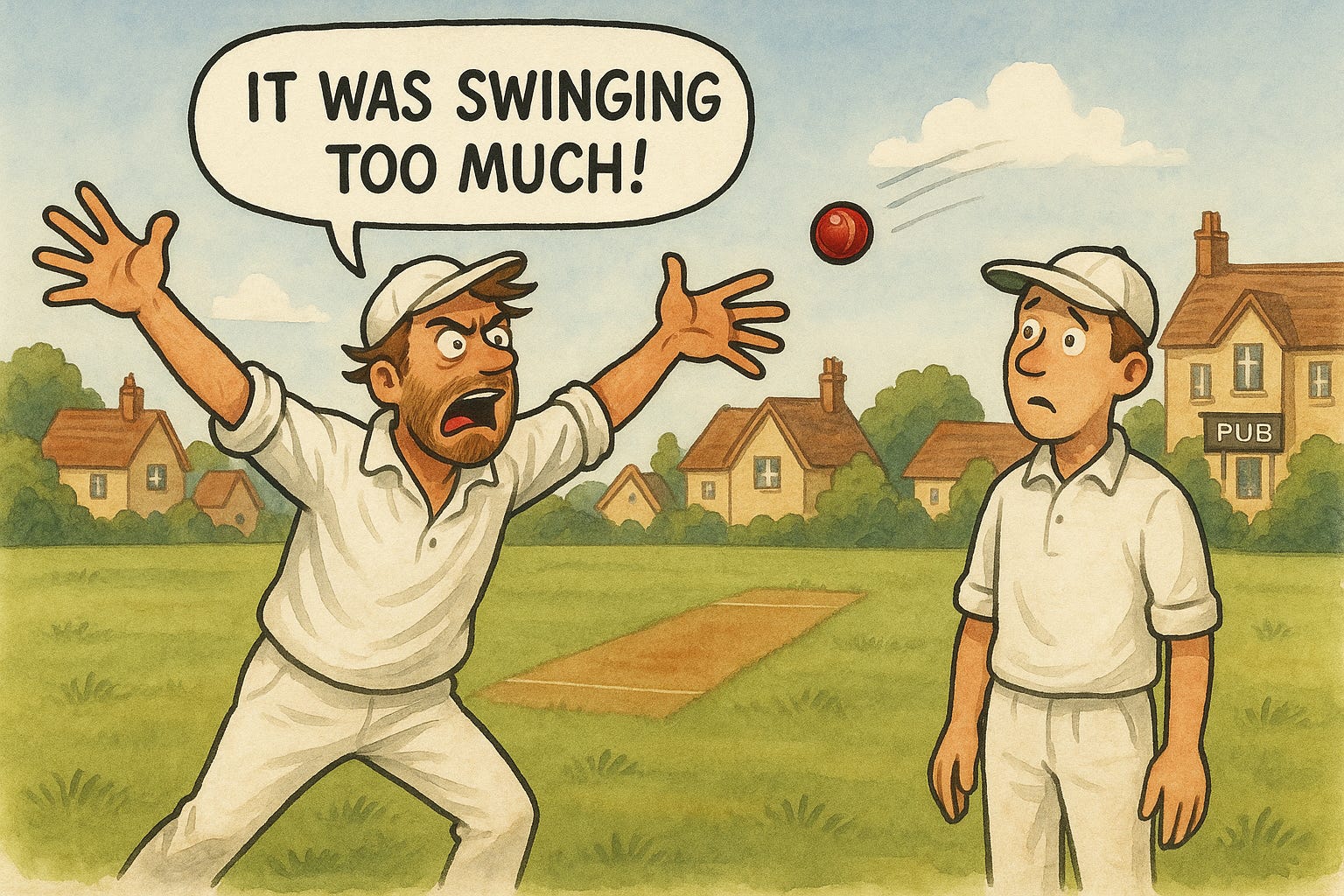
Make a lot of excuses, for example, if you bowl a wide, it’s because it’s swinging too much.
Always blame the fielders. If you bowl a crap ball the batsman pulverises and the fielder fails to stop, it’s entirely their fault.
Likewise, if the same thing happens with a catch a professional player might have got a finger to, you must react as if they’ve been gently chucked the ball by a child.
Here’s what these sometimes unhinged and volatile characters are trying to do.
Bowling
Yorker: Rarely seen in village cricket, this is a ball pitched right at the batter’s feet at speed. It’s difficult to play and can lead to the stumps splattering or an LBW. Protocol is to praise any batter who manages to stop it.
The legendary Pakistan bowler Waqar Younis had a ferocious yorker known as the “Toe Crusher.”
Research suggests this is originated in Yorkshire, England, where bowlers were said to be skilled at delivering balls that would deceive the batter by landing right at their feet.
This could well be nonsense made up by Yorkshire people, who are well-known for outrageous promotion of their home county, despite it spawning Geoff Boycott, something most of us would try to hide.
(You always know if someone is from Yorkshire because they proudly announce it, quite often before you’ve learned their name.)
Bouncer: A short-pitched ball that rises toward the batter’s head.
Full Toss: A ball that reaches the batter without bouncing.
Maiden Over: An over in which no runs are scored off the bat.
The word “maiden” historically refers to a young, unmarried woman — symbolizing purity or untouched status. So in cricket, a maiden over is one that remains “untouched” by the bat in terms of scoring — a clean, run-free over.
Now I’ve learned that, it’s actually a bit weird.
Economy Rate: Average number of runs conceded per over (bowlers care about this, no one else does, unless it gets massive, then you can rip into them)
Spin Bowling: Use fingers or wrist to impart spin to the ball so that it deviates when hitting the ground, thereby deceiving the batter
Off-spin: Turns from off to leg for a right-handed batter.
Leg-spin: Turns from leg to off.
Googly: A leg-spinner’s delivery that turns the opposite way.
Seam Bowling: Relies on pace and seam position to move the ball off the pitch.
Swing Bowling: Uses air movement to curve the ball while in flight, swing can be both in towards the batter and out away from the batter.
There is also something called reverse swing, some bowlers claim they can bowl this. They can’t.
Appeal: This occurs when there is a potential LBW, catch by the keeper, run out or stumping.
Ancient bowlers tend to ask the umpire “How was he?”, youngsters ask “Howzat (How Was That?).
The umpire then has to make the decision whether the batter is out or not.
Correct protocol for this is to praise him generously if he agrees and secretly call him a “w**ker” under your breath if he doesn’t.
Fielding
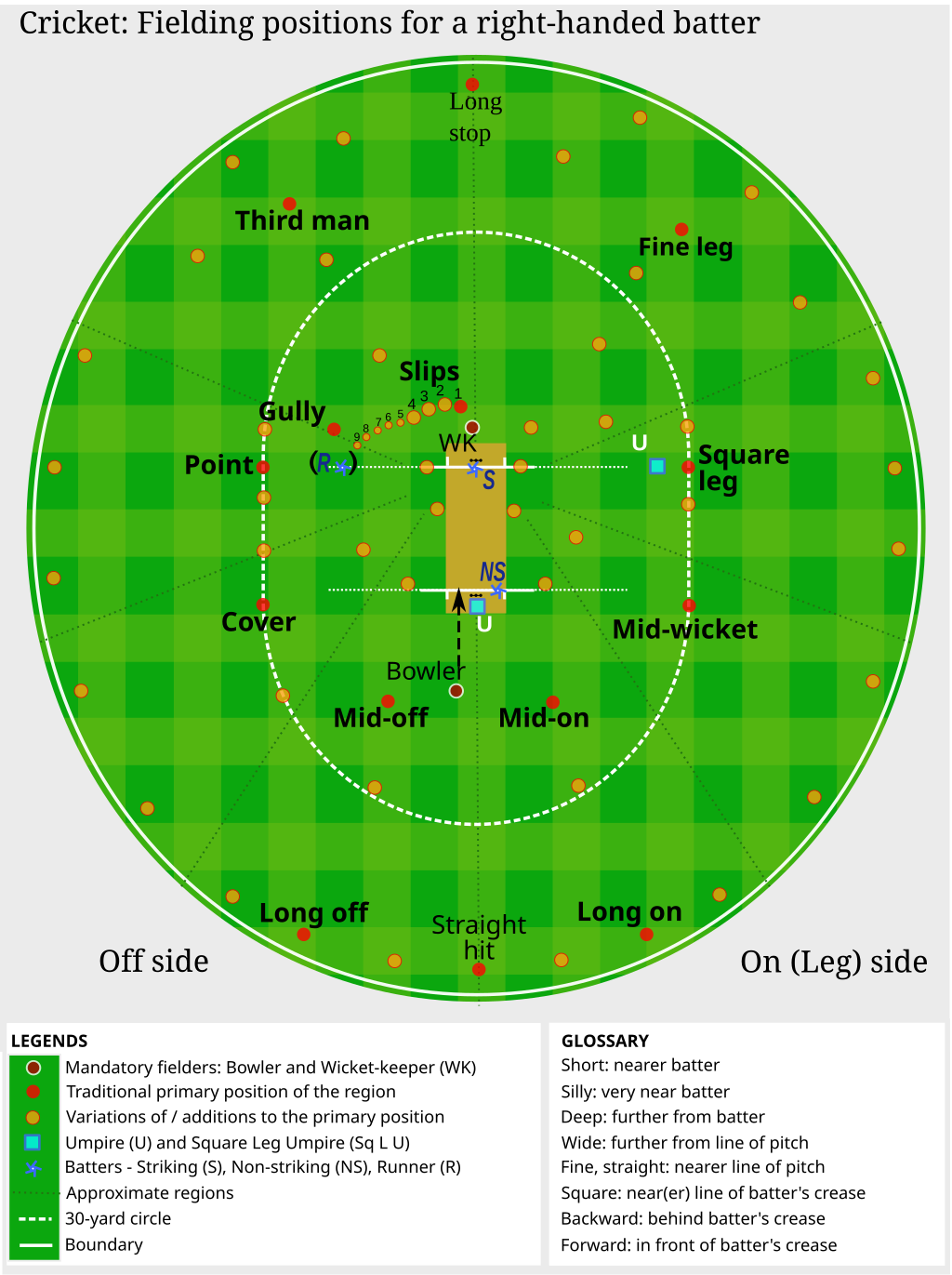
Wicketkeeper: The most important fielding position. The ‘keeper is tasked with catching the ball after it’s bowled. They’re also responsible for collecting the ball when it’s thrown back. The demands of the job mean they get to wear padded gloves, pads and a helmet when needed.
They also tend to talk constantly throughout the innings and get very excited about mediocre deliveries. A good one can win you matches and a bad one can lose them and upset the bowlers for weeks.
Slip: Fielder placed behind the batter on the off side, next to the wicketkeeper, either old fat blokes who are useless elsewhere or young, athletic types who might actually catch the ball. Slip catches are invariably very hard.
Gully: Slightly wider than the slips; catches (drops) edged balls.
Mid-on / Mid-off: Close to the bowler, on the leg and off-side respectively.
Cover: A fielder in the prime scoring area of the batter’s off-side, often the best in the team.
Midwicket: Opposite cover on the leg side.
Point: Adjacent to the batter on the off side.
Square leg: Same but on the leg side, there’s also an umpire here you can chat to, leading to dropped catches and misfields.
Silly Point: A very close fielding position on the off-side, the “silly” refers to the closeness of the fielder and the possibility of them getting clobbered by the ball.
Third Man / Fine Leg: Positioned near the boundary behind the batter.
Overthrows: These have a great many local names. One of our lads calls them “buzzers”, my dad said the Etonian term was the typically unoriginal “ovies” and I call them “f**king overthrows.”
These occur when a fielder collects the ball and returns it to either the keeper or the bowler, who misses it, leading to the batting side accumulating undeserved extra runs. They make captains very cross.
Cricket Results
All Out: When 10 wickets fall and the innings ends.
Draw: In Test cricket, when time runs out before a result it is a draw. It happens when the side batting hasn’t reached the total or been bowled out. Local cricket still has a rarely-seen version which can end in a draw that has been gradually phased out as people realised it was too boring.
Tie: Both teams score exactly the same runs with all innings complete.
In most sports, a tie and a draw are the same, not cricket.
No Result: In limited-overs, a match abandoned due to weather with insufficient overs bowled.
Dismissals
Bowled: The Bowler hits the stumps. The bails MUST be knocked off for the wicket to count.
LBW: Leg Before Wicket. The ball hits the batter’s legs and would’ve gone on to hit the stumps/wicket.
No batter in cricket history has ever agreed with an LBW decision.
Caught: Batter whacks it straight to a fielder, who catches it. Usually results in swearing.
Run Out: A batter is dismissed when a fielder breaks the stumps while the batter is out of their crease attempting a run. This is often a result of a total breakdown in communication, leading to epic fallouts and more swearing.
Stumped: The batter leaves the crease and misses the ball, the wicketkeeper catches it and removes the bails before they can get back.
Hit Wicket: The batter hits the wicket/stumps with their bat or part of their body. It’s possible to get out hit wicket having hit the ball.
Handled the ball: A rare one where the batsman uses their hand to stop the ball hitting their stumps/wicket. Conversely, it’s entirely legal to kick the ball away to stop it hitting your stumps.
Obstructing the field: This occurs when a batter fears they are about to be run out/caught and makes an attempt to block the fielder from catching/picking up the ball.
Hit the ball twice: This is an obscure rule designed to stop a batter gently blocking a ball with one movement and then whacking it the next. Do this and you’re back in the pavilion.
Timed out: Technically, a batter can be given out if they take too long to get to the wicket.
(In 30 years, I’ve never seen anyone out handled the ball, obstructing the field, hit the ball twice or timed out).
The Officials
Umpires
Bizarrely, in low-level cricket, members of the batting side are trusted to honestly make decisions against their teammates.
This sometimes leads to cheating and sometimes leads to people thinking it’s hilarious to give their mates terrible decisions.
I was once given out by our club umpire because he was “bored of watching you miss the ball”
There are two umpires.
Bowler’s end umpire: It’s this umpire’s job to count the balls bowled (This is harder than it sounds), check for no balls and wides, and try to work out whether a batter is out or not.
Square leg umpire: Their roles include chatting to the nearby fielder about how their season is going, but also giving stumpings and run-out decisions.
Scorer: In the old days this was done in a book, and uses a complex system that I cannot be bothered to explain to calculate the batters’ scores, the bowlers’ figures and the team’s total score.
The only rule was that under no circumstances should these three totals ever be the same, and that the person tasked with this must grumpily sit there trying to work out where it’s gone wrong.
Happily, we now have an online system that is pretty swish and does it all for you.
And we’re there with our guide to official cricket terminology, coming soon is another guide to cricket slang which will hopefully be a lot shorter.