There has been a lot of talk in the thrilling test series between England and India about the ball.
The Duke ball has been slammed by old pros who now write grumpy columns in newspapers about how quickly it becomes egg-shaped.
We use Duke balls for our league matches, and they’re miles better than the crappy ones we use for Sunday games which often wear out after 10 overs of dibbly-dobbly medium pace.
Plus I’ve yet to see any of the England players rooting around in a hedge looking for the Duke after an agricultural shot by a big fat bloke.
The talk reminded me of a ludicrous incident in the village of Theale in Berkshire.
Normally, people who live near cricket grounds accept there’s a risk of balls hitting things, or going into their gardens.
There have been legal spats over this (more on this later) but generally people understand the cricket pitch was there first and that this is a risk.
“Can We Have Our Ball Back?”
Theale’s ground is by a road, with houses on the other side.
We were batting and the ball got whacked into the road, and smacked into the side of a car with a resounding “thud.
Cars getting hit isn’t uncommon, and in fact, many years ago, I hit a four which walloped my old, metallic green Peugeot 106 and cracked its number plate.
The Theale players looked at each other with a sense of familiar dread in their eyes.
To our amusement, a cry of “you tossers!” was heard, and the man whose car it was had appeared.
Play then stopped for several minutes, before the Theale captain sheepishly appeared to explain what had happened.
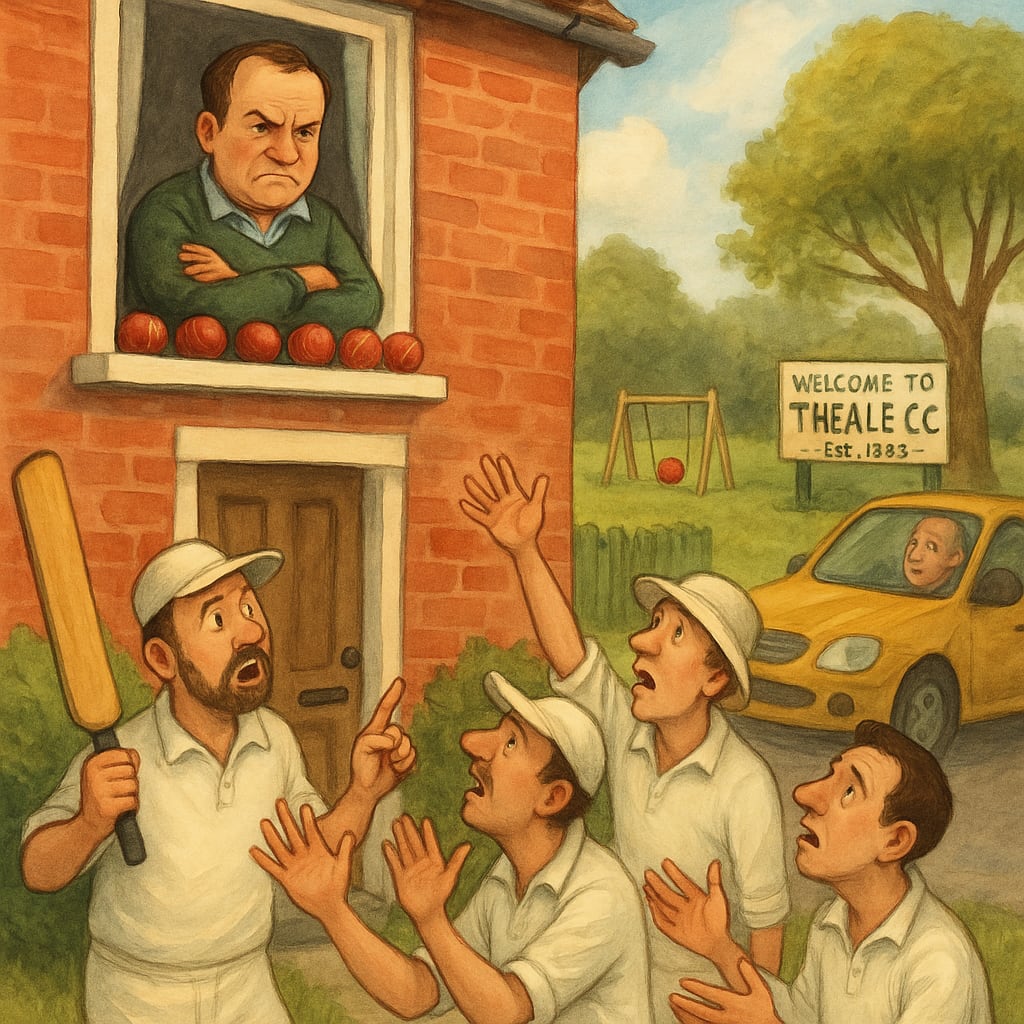
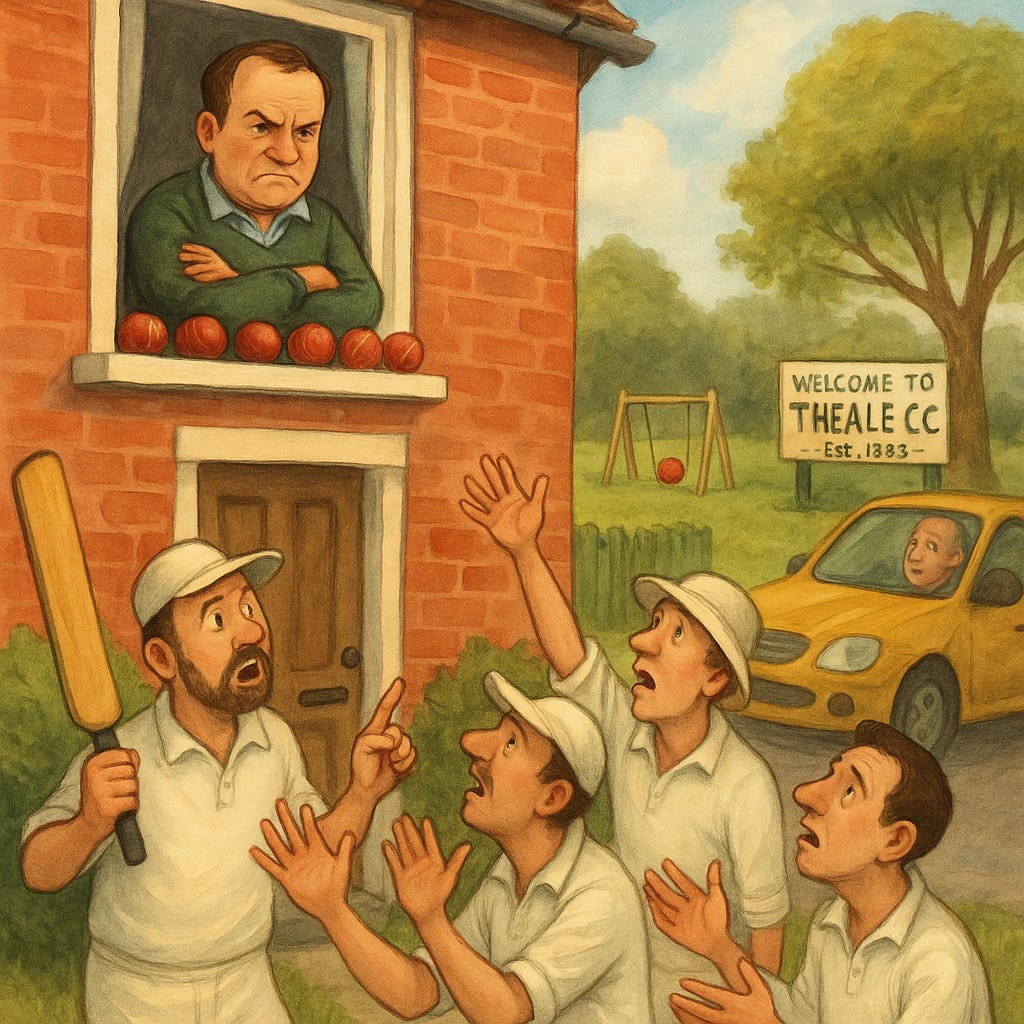
The man, enraged by the (extremely minor) damage to his (ancient) car, had found the ball and taken it into his house, refusing to return it.
Bemused motorists were greeted by the sight of a group of men in white arguing with a stubborn middle-aged man who wouldn’t give them their ball back.
Eventually in this case, he gave it back.
It was later explained, “he does it all the time”, and that it was thought he had a collection of errant cricket balls inside his house.
It always amuses me when people who buy homes near cricket grounds get annoyed by cricket-related things affecting those homes.
It’s like people who buy cheap houses near airports being shocked about how noisy aeroplanes are.
But I was actually impressed by the pettiness of this fellow and his ongoing feud with the cricket club.
We still play Theale, and are hopefully going there in 2026 to play.
Part of me hopes the man is still there and that another “Please sir, can we have our ball back?” incident occurs.
Read More:
Smashed Windscreens, Broken Roof Tiles and a Dented Rover 2000
My father is also very proud of his own exploits, having smashed a couple of windscreens and some rooftiles.
He told me this:
“I once hit a six that landed on the roof of a man’s Rover 2000, creating a large dent.
“This was as he was cleaning it in his front garden. He looked quite upset.”
Another more alarming incident saw a ball clang into the frame of a swing yards from where a little girl was having the time of her young life.
The nearest miss of all was at a rec on the outskirts of Reading.
A young couple were walking their dog in the outfield when a ball was absolutely thumped to the boundary.
The boyfriend saw the ball hurtling towards him, taking evasive action.
His girlfriend was looking the other way.
Fortunately, it narrowly missed hitting her in the side of the head.
This was a very close call that could’ve easily ended up with her being seriously hurt.
On a lighter note, there’s this excellent clip on YouTube where a man hits the ball through his own windscreen.
Miller vs Jackson
Behaviour like the bloke in Theale isn’t new.
The famous legal case Miller vs Jackson took place in the mid-1970s.
The Millers had moved into a new build in the village of Lintz in County Durham, near to the local cricket ground (which had been there since 1905).
They were rather surprised to find cricket matches taking place at the cricket ground, which led to the occasional ball landing in or near their new house.
Shocked by cricket being played at a cricket ground every weekend for 72 years near their house, the couple tried to put a stop to it.
This was in spite of the club taking measures to reduce the damage by putting fences up and (I love this) asking the players not to hit sixes into the neighbour’s garden.
The couple not only took legal action, but managed to both get cricket banned in the village and an award of £150 in damages (£1,072 in modern money).
A Different Type Of Cricket Appeal
Most appeals in cricket involve shouting/begging the umpire to give a batter out.
This one happened in a court room.
The cricket club, quite rightly, appealed the judge’s decision to ban their beloved sport.
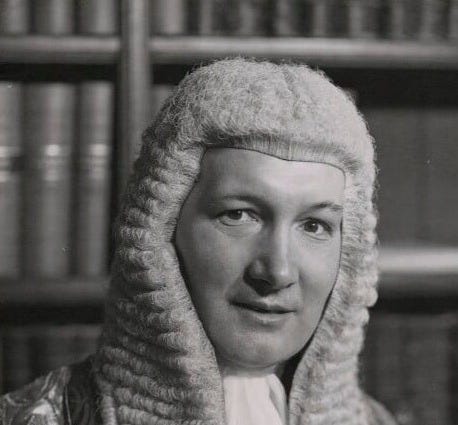
The case reached the Court of Appeal, which was governed by one Lord Denning.
Lord Denning, clearly a man of great sense, threw out the initial injunction.
The following quote is one of the most English things ever said, and is best read in as hoity-toity posho public school accent as you can muster. Note his contempt for the “Newcomers.”
(In fact, unusually for judges at the time, Lord Denning had a strong Hampshire burr.)
He said:
“In summertime village cricket is the delight of everyone.
“Nearly every village has its own cricket field where the young men play and the old men watch.
“In the village of Lintz in County Durham they have their own ground, where they have played these last 70 years.
“They tend it well.
“The wicket area is well rolled and mown.
“The outfield is kept short.
“It has a good club house for the players and seats for the onlookers.
“The village team play there on Saturdays and Sundays.
“They belong to a league, competing with the neighbouring villages.
“On other evenings after work they practise while the light lasts.
He went on to say:
“Yet now after these 70 years a judge of the High Court has ordered that they must not play there any more. He has issued an injunction to stop them.
“He has done it at the instance of a newcomer who is no lover of cricket.
“This newcomer has built, or has had built for him, a house on the edge of the cricket ground which four years ago was a field where cattle grazed.
“The animals did not mind the cricket.
“But now this adjoining field has been turned into a housing estate.
“The newcomer bought one of the houses on the edge of the cricket ground.
“No doubt the open space was a selling point.
“Now he complains that when a batsman hits a six the ball has been known to land in his garden or on or near his house.
“His wife has got so upset about it that they always go out at week-ends.
“They do not go into the garden when cricket is being played.
“They say that this is intolerable.
“So they asked the judge to stop the cricket being played.
“And the judge, much against his will, has felt that he must order the cricket to be stopped: with the consequence, I suppose, that the Lintz Cricket Club will disappear. “
“The cricket ground will be turned to some other use. I expect for more houses or a factory. The young men will turn to other things instead of cricket.
“The whole village will be much the poorer. And all this because of a newcomer who has just bought a house there next to the cricket ground.”
The injunction was overturned, with the court ruling:
“The Millers had bought a house with the benefit of an open space adjacent to their land, and had to accept that the innocent and lawful use of the open land could restrict the enjoyment of their garden.”
The cricket club agreed to pay £400 in damages to the couple to cover any massive sixes that did knock off their roof tiles.
The final entry in the Wikipedia entry of this fascinating case is one of great beauty, it simply says:
“Not long after the case, the Millers moved house.”